


A Stew Peters Exclusive: USS Liberty Attack Survivors Tell Their Story and Call for Justice
Two brave souls, Larry Bowen and Chaplain Ron Kukal, open up about their harrowing experiences during that fateful day in 1967.
It's more than just a retelling of history; it's a call to arms for all patriots to ensure that the sacrifices and truths of that day are never forgotten, and to push forward in our pursuit of justice.
Additional Background, Excerpted from The Office of the Historian, FOREIGN RELATIONS OF THE UNITED STATES, 1964–1968, VOLUME XIX, ARAB-ISRAELI CRISIS AND WAR, 1967
Washington, June 13, 1967.
THE ISRAELI ATTACK ON THE USS LIBERTY
The US Naval technical research ship Liberty was attacked by Israeli aircraft and torpedo boats off the Sinai Peninsula on 8 June. The following account of the circumstances of the attack has been compiled from all available sources.
The Liberty reported at 9:50 a.m. (2:50 a.m. Washington time) on 8 June that it had been orbited by two delta-wing jet fighters, presumably Israeli Mirages. At 3:05 p.m. (8:05 a.m.) the Liberty was strafed by unidentified jet aircraft. The Liberty apparently was not able to establish communications with other units of the US Sixth Fleet during the air attack, and the first information available to the US commanders was after the subsequent attack by unidentified torpedo boats, which occurred at 3:25 p.m.
At 4:11 p.m. (9:11 a.m.) the US Commander in Chief, Europe, notified the National Military Command Center in Washington that the Liberty was under attack and was listing to starboard after being struck by a torpedo. The Commander of the US Sixth Fleet declared the attacking units hostile and sent attack aircraft from the carriers America and Saratoga to protect the Liberty. A good part of the ship’s communications equipment was destroyed by the crew during the attack but emergency communications were soon established with the Saratoga and with the naval communications station in Greece. Because of the tenseness of the situation and the communications delays, the initial reports from the Liberty were sketchy and somewhat confusing.
Specifics of the Attack
- According to these reports, however, the sequence of events took place as follows. The ship was attacked at 3:05 p.m. (8:05 a.m.) by [[Page 470]](https://history.state.gov/historicaldocuments/frus1964-68v19/pg_470)unidentified jet fighters, believed to be Israeli, at position 31–35N, 33–29E. Six strafing runs were made by the jets. Twenty minutes later three torpedo boats closed at high speed and two of them launched torpedoes after first circling the Liberty. One torpedo passed astern, and the other struck the starboard side of the ship in the spaces occupied by the SIGINT collectors. One of the boats was later identified as Israeli and the hull number of one unit was noted as 206–T. Some 50 minutes later two Israeli helicopters arrived on the scene.
Israeli Identification of the Ship
None of the communications of the attacking aircraft and torpedo boats is available, but the intercepted conversations between the helicopter pilots and the control tower at Hatzor (near Tel Aviv) leave little doubt that the Israelis failed to identify the Liberty as a US ship before or during the attack. Control told (helicopter) 815 at 3:31 p.m. (8:31 a.m.) that “there is a warship there which we attacked. The men jumped into the water from it. You will try to rescue them.” Although there were other references to a search for the men in the water and although US units later searched the area, no survivors were recovered from the sea, nor were there any indications that any of the 22 missing personnel from the Liberty had been lost overboard.
A subsequent message from the control tower to the helicopter identified the ship as Egyptian and told the pilot to return home. Although the Liberty is some 200 feet longer than the Egyptian transport El Quesir, it could easily be mistaken for the latter vessel by an overzealous pilot. Both ships have similar hulls and arrangements of masts and stack.
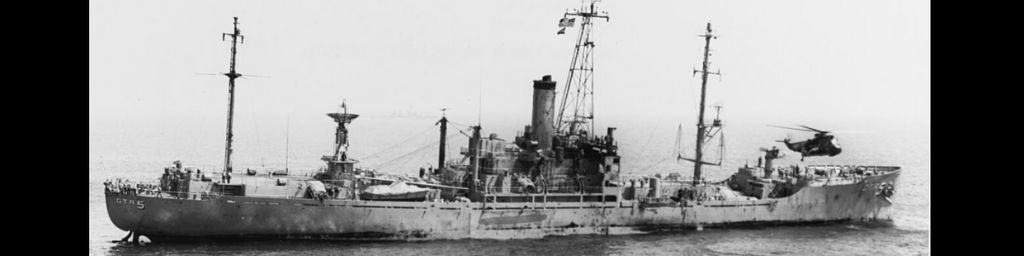
The weather was clear in the area of attack, the Liberty’s hull number (GTR 5) was prominently displayed, and an American flag was flying. The helicopter pilot was then urgently requested to identify the survivors as Egyptian or English speaking (this being the first indication that the Israelis suspected they may have attacked a neutral ship). The helicopter pilot reported seeing an American flag on the Liberty. In another intercept between an unidentified Israeli controller and the helicopter number 815, the pilot reported that number GTR 5 was written on the ship’s side. The controller told the pilot the number had no significance.
Thus it was not until 4:12 p.m. (9:12 a.m.) that the Israelis became convinced that the Liberty was American. This was about 44 minutes after the last attack on the ship and the attack had apparently been called off, not because the ship had been identified, but because it seemed to be sinking. (The US Defense Attaché in Tel Aviv reports that Israeli helicopters and the three torpedo boats searched the area until 6:04 p.m. (11:04 a.m.).) The Israeli offer of assistance was declined [[Page 471]](https://history.state.gov/historicaldocuments/frus1964-68v19/pg_471)because of the sensitive mission of the ship. According to US Navy reports, the ship was saved only through the efforts of her crew.
Damage and Personnel Losses
- The ship suffered heavy material and personnel casualties. A hole estimated to be 39 feet wide at the bottom and 24 feet wide at the top near the waterline was opened by a torpedo. The ship is flooded below the second deck between frames 52 and 78 (36-inch frame spacing). The crew carried out emergency destruction of classified communications and radar equipment, but the ship’s engineering plant is intact. Several flash fires and cannon holes throughout the superstructure caused some minor damage and the ship’s motor whale boat and virtually all of its life rafts were lost. Personnel casualties include 10 killed, 90 wounded, and 22 missing, most of whom were probably trapped in the flooded compartments. The wounded and the dead have been removed from the ship and some additional crew members put aboard. The ship is expected to arrive in Malta on 14 June for dry docking and hull repairs. Security precautions are being taken to protect the classified intercept equipment in the flooded spaces. The US Navy has convened a board of inquiry to look into the incident.
The Ship and Its Orders
The USS Liberty is a converted Victory class merchant ship utilized as a SIGINT collector. The unit had moved from its normal station off West Africa to provide additional SIGINT coverage of the Middle East crisis. Official US statements, however, have described the Liberty as an electronics research ship which had been diverted to the crisis area to act as a radio relay station for US embassies.
The Liberty sailed from Rota, Spain, on 2 June under orders to patrol no closer than 12.5 miles of the UAR coast and 6.5 miles of the Israeli coast. A modification of orders issued by the Commander of the US Sixth Fleet at 12:17 p.m. (5:17 a.m.) on 8 June had not been received aboard the Liberty, according to the ship’s commanding officer, before the Israeli attack. This change, together with messages from other commands which ordered the Liberty to approach no closer than 100 miles of the coasts of the UAR and Israel and 25 miles of the coast of Cyprus, was delayed in transmission in part because of a misunderstanding of responsibilities for delivery.